Admission Requirements
Undergraduate Admissions Requirements
-
Completed application
-
Official transcripts
Facilities & Technology
Center for Architectural Studies
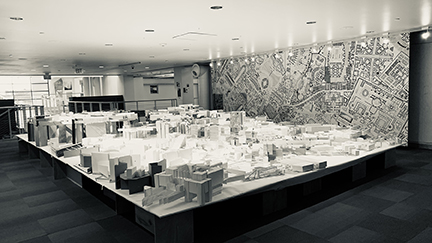
In some cases, where students learn can be as important as what they learn. Where it can be a modern urban center or a historic city like Florence, or it can be a building so innovative in its design that it becomes a partner in the educational experience. Such is the case with Marywood’s Center for Architectural Studies, which houses the School of Architecture.
The School of Architecture is a state-of-the-art example of sustainable design. It's a spacious, adaptive re-use of Marywood's former gymnasium and natatorium. It features:
- Two levels of open studios
- Wood and metal shops
- Digital Fabrication Lab
- Plaster-casting room
- Printers and plotters
- Construction Materials Lab
- Reference library
A two-story commons under a continuous skylight harvests abundant natural light throughout the day and serves as the building's "agora" - an open, shared, central space for educational exchanges among students and faculty. This is an ideal place for group discussions, debates, displays, and project critiques.
 Entrance to the building with student work displayed
School of Architecture Classrooms
A two-story commons under a continuous skylight harvests abundant natural light throughout the day and serves as the building's "agora" - an open, shared, central space for educational exchanges among students and faculty. This is an ideal place for group discussions, debates, displays, and project critiques.
Every student is provided an individual work space with a drawing board, personal storage area, pin-up wall, and space for a laptop.
It features:
- Two levels of studio space
- Fully-equipped woodshop
- Plaster-casting room
- Printers and plotters
- Computer-Aided Design (CAD) lab
- Student lounge
- Reference library


Cloud Room
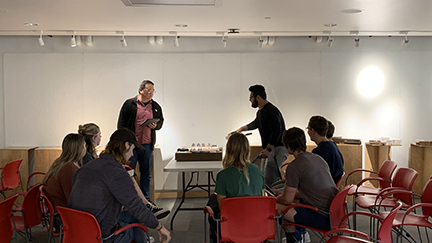
The Cloud Room (CAS 251) is located on the second level of the Center for Architectural Studies, above the lobby. Including only chairs without desks, it is not considered a traditional classroom space. The Cloud Room is used by the School of Architecture as a meeting space and as a location for architecture lectures and guest speakers.
Scholarships
Morris K. Udall Scholarship
The Udall Foundation seeks future leaders across a wide spectrum of environmental fields, including policy, engineering, science, education, urban planning and renewal, business, health, justice, and economics. The Foundation also seeks future Native American and Alaska Native leaders in public and community health care, tribal government, and public policy affecting Native American communities, including land and resource management, economic development, and education.
Courses & Curriculum (120 Total Credits)
The four-year Bachelor of Environmental Design in Architecture (BEDA) degree program at Marywood is a pre-professional degree. Marywood offers advanced standing in their professional Master of Architecture (MARCH) and Master of Interior Architecture (MIA) programs for students with undergraduate degrees in Environmental Design, Architecture, Interior Architecture, Virtual Architecture, and Construction Management. Most jurisdictions require the addition of a professional Master of Architecture to become an architect.
The Bachelor of Environmental Design in Architecture degree program requires study abroad in the third year in Florence. Students with extenuating circumstances outlined in the MU SOA Study Abroad Policy may apply for an exemption.
A minimum grade of “C” is required in order to fulfill the University’s requirement of design competency in each of the following studio courses: ARCH 110, ARCH 120, ARCH 210, ARCH 220, ARCH 310, ARCH 320, ARCH 410, and ARCH 420.
B.E.D.A. (Four-year pre-professional degree) Program Requirements
Total of 120 credits required including:
-
Core curriculum*
-
Environmental Design in Architecture curriculum
-
General Electives
The Environmental Design in Architecture curriculum is scaffolded by four curricular sequences listed below. Please email the MUSOA Director at architecture@marywood.edu for a recommended, semester-by-semester curriculum tracker outlining the four-year program.
Studio Sequence
|
ARCH 110 |
Design Studio I |
4 |
|
ARCH 120 |
Design Studio II |
4 |
|
ARCH 210 |
Design Studio III |
6 |
|
ARCH 220 |
Design Studio IV |
6 |
|
ARCH 310 |
Design Studio V |
6 |
|
ARCH 320 |
Design Studio VI |
6 |
|
ARCH 410 |
Design Studio VII |
6 |
|
ARCH 420 |
Design Studio VIII |
6 |
Representation Sequence
|
IARC 111L |
Hybrid Representation Lab I |
2 |
|
IARC 121L |
Hybrid Representation Lab II |
2 |
|
IARC 211L |
Hybrid Representation Lab III |
2 |
Technology Sequence
|
ARCH 127 |
Building Technologies I |
3 |
|
ARCH 217 |
Building Technologies II |
3 |
|
ARCH 227 |
Building Technologies III |
3 |
|
ARCH 317 |
Building Technologies IV |
3 |
|
ARCH 417 |
Building Technologies V |
3 |
|
ARCH 427 |
Building Technologies VI |
3 |
History and Theory Sequence
|
ARCH 128 |
Hist & Thry of Arch & Interior Arch I |
3 |
|
ARCH 218 |
Hist & Thry of Arch & Interior Arch II |
3 |
|
ARCH 228 |
Hist & Thry of Arch & Interior Arch III |
3 |
Total Credit Hours: 120
An additional 9 credits of program electives are required.**
* MATH 160 and PHYS 140 are required to fulfill Math and Physical Science Core requirements for Bachelor of Environmental Design in Architecture students. Equivalent or higher courses will be accepted on a case-by-case basis.
** Program Electives shall be selected from Architecture, Interior Architecture, Construction Management, Virtual Architecture, and other courses approved by the MU SOA Director. Program Electives shall not be otherwise required courses in the Bachelor of Environmental Design in Architecture degree program.
Faculty
Dr. Jodi L La Coe
Director, School of Architecture | Associate Professor
Arian Korkuti
Associate Director of Graduate Studies | Assistant Professor
Dr. Liyang Ding
Associate Professor | Associate Director of Undergraduate Studies
Scott D Allen
Assistant Professor of Practice
Dr. Elizabeth M Andrzejewski
Associate Professor
Catherine M Armezzani
Instructor of Practice
Xenia Barbaro
Instructor of Practice
Simone Barbi
Instructor of Practice
Norvell L Bartow
Lecturer
Alexander J Belavitz
Lecturer
Joshua David Berman
Assistant Professor of Practice
Amy L Brakefield
Lecturer
Charles J Breig
Lecturer
Tess R Brown
Lecturer
Dr. Miguel Angel Calvo-Salve
Professor
Matthew Chorba
Lecturer
Carmen J Ciampi
Lecturer
Antonio Felice Cicco
Lecturer
Isabella Louise Coleman
Lecturer
Emanuele Cremona
Lecturer
Emily Elizabeth Fischetti
Lecturer
Michael A Fusco
Lecturer
Ali Ghazvinian
Assistant Professor
Negar Goljan
Lecturer
Thomas Alexander Gongliewski
Shop Manager/Technician
Kimberley Ann Hagan
Instructor
Kelsey N Hanson
Lecturer
Christian T Hoffer
Lecturer
Gerard Jacquinot
Lecturer
Robert Kane
Lecturer
Michael Lawson
Lecturer
Joseph Thomas Leone
Digital Output Technician
Lincoln L Lewis
Lecturer
William R Long
Lecturer
Christopher J Loofs
Assistant Professor
Maria N MacDonald
Instructor of Practice
Joseph R Marcellus
Lecturer
Nicolas A Mendez
Lecturer
Salikuddin Mohammed
Graduate Assistant | Lecturer
Scott S Napkora
Lecturer
Blake Charles Nickel
Work Study Students | Lecturer
Michelle L Pannone
Associate Professor
Mario Joseph Paoli
Graduate Assistant - FWS | Lecturer
Dr. Arturo Pavani
Assistant Professor
Megan M Pavlowski
Lecturer
Tommaso Pediani
Lecturer
Franco Pisani
Lecturer
Gustavo Alfredo PulidoDelCastillo
Assistant Professor of Practice
Derrick P Ricci-Riner
Lecturer
Lucia J Riggi-Murray
Study Abroad Coordinator | Administrative Assistant
Sean M Ritter
Lecturer
Renee Lynn Rozaieski
Lecturer
Ryan Scavnicky
Assistant Professor
Kerry P Schimelfenig
Lecturer
Jordan M Slater
Lecturer
Lewis Strunk
Lecturer
Paige Leigha Stryshak
Lecturer
James J Sullivan
Professor
David M Truitt
Lecturer
Philip Martin Vigoda
Lecturer
Benjamin A Washington
Lecturer
Kristen Anne Wolfe
Lecturer
From #DayOne, Marywood is here for you each step of the way.