Create Success with a BFA in Graphic Design Visual Arts
Why is Marywood University continuously ranked amongst the best graphic design schools in Pennsylvania year after year?
It’s our commitment to providing students with a unique blend of theoretical knowledge and practical skills. Marywood's Graphic Design program not only focuses on the technical aspects of design, but also on the conceptual and creative aspects. This holistic approach ensures that students are well-equipped to tackle any design challenge that comes their way.
One of the key features of the Graphic Design program is its emphasis on industry experience. Our award-winning faculty and guest lecturers encourage Visual Arts students to gain practical experience through internships and work placements. The hands-on experience allows students to apply the skills they have learned in the classroom to real-world scenarios. It also gives them a taste of what it's like to have a career in graphic design.
The Graphic Design curriculum includes courses in typography, graphic and digital design, illustration, web design, interactive media, and more. In the first year, students focus on foundational courses to develop their understanding of design principles. In the second and third years, students delve deeper into specific areas of graphic design. In the final year, students prepare portfolios in preparation for entering the workforce while they undertake a capstone project and exhibition that allows them to showcase their skills and creativity.
Graduating from Marywood with a BFA in Graphic Design opens up a world of opportunities in the world of visual arts. There are also many other opportunities and areas within graphic design that you can explore. The art field, specifically graphic design, is
projected to grow 3% from 2028 to 2031 (opens in a new window)
,
leading to new specialties and career paths each passing year.
Marywood has a blog called
Where Creativity Works
where art students share tips, artwork, blog writings and more to expand their disciplines and exposure.
Gallery Spaces
Marywood University has five gallery spaces on campus that provide students with hands-on learning experiences. These galleries offer opportunities to participate in art shows and showcases, allowing students to display their work, gain practical experience in exhibition processes, and connect with the artistic community. This helps foster both creative growth and professional development.
Personalized Attention
With an 11:1 student-to-faculty ratio, Marywood offers personalized attention from highly qualified faculty who are experienced professionals who bring real-world industry insight directly into the classroom.
Portfolio Submission Guidelines for Art Undergraduates
Applying and getting accepted into the Marywood University Art Department is a two-step process. Both steps must occur prior to enrollment in your first semester courses.
APPLY
Apply to the University using the
Marywood application
or the
Common application
. Incoming first time freshmen interested in priority consideration for the Art Department's Art Talent Award should concurrently submit their portfolio materials directly to the Art Department prior to the November 15 deadline. Portfolios received after November 15 and before the cut off date of March 1 are still eligible for consideration depending on remaining awards.
PORTFOLIO
Submit your portfolio to the Art Department.Your submission should include 1) your portfolio, 2)
submission checklist
, and 3) short art essay (see below).
Every art student at Marywood has access to superb facilities in our two art buildings, from computer labs and darkrooms to drawing, painting, printmaking, metal, wood, and sculpture studios and weaving looms. Facilities are available to art students 24 hours a day, seven days a week. Marywood is also home to four galleries on campus featuring regional and national artists, faculty, and students.
The Insalaco Center for Studio Art
features drawing and painting studios showcasing naturally lit rooms with beautiful views of the campus. There are studios and equipment for woodworking, fiber arts, jewelry-making, ceramics, sculpture, photography, printmaking, a multipurpose classrooms with printers, and private and semi-private studios for upper level BFA, MA and MFA students.
The Mahady Gallery
is an open and elegant setting for the display of contemporary artwork. Throughout the year, the gallery offers a variety of group and solo shows by visiting artists, juried regional competitions, faculty exhibits, student shows, and curated national exhibitions. The gallery hosts the annual Scholastic Art Awards and the popular Art Faculty Biennial. Featured exhibitions are accompanied by artists’ slide presentations, gallery talks, studio visits, and demonstrations. The Mahady Gallery is located on the first floor of the Insalaco Center for Studio Arts.
Exhibitions in
the Suraci Gallery
showcase regional and national artists; support art faculty work and scholarship; provide degree research and documentation opportunities for current and alumni art students; and foster community outreach projects and interests. The Suraci Gallery also houses Marywood’s permanent collection of fine and decorative art. The Asian Collection consists of ceramics, furniture, netsukes, inro, ivories, and prints. Bronze and marble sculpture, paintings, ceramics, glass, and French ivories comprise the 19th Century Collection. Religious icons, furniture, and 20th century works round out the Suraci Collection. The Suraci Gallery is located on the second floor of the Shields Center for Visual Arts.
Located in the lobby of the Insalaco Center for Studio Arts,
the Kresge Gallery
is a versatile exhibition, critique, and lecture space. An alternative venue to the formal art galleries, the Kresge Gallery provides a working and experimental exhibition site for art students and faculty to showcase a variety of work throughout each semester. Recent exhibitions include the Foundation Year student show, Senior Exhibition, Advanced Painting & Sculpture shows, MA and MFA shows, the Marywood Print Guild show, Design & Letterpress shows, art auctions, and student Art Club exhibitions.
Shields Center for Visual Arts
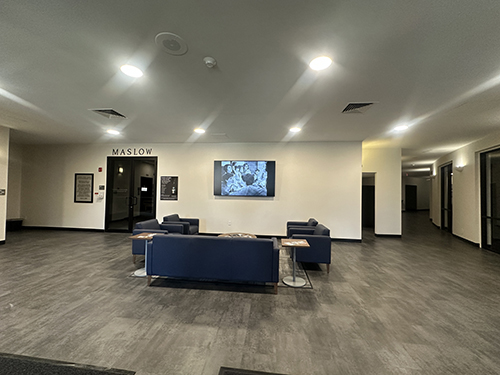
The Shields Center for Visual Arts building contains The Maslow Collection, Mahady Gallery, Suraci Gallery, classrooms for the art history and arts administration programs, studios for art therapy, two graphic design Mac labs, and a 24-hour drop-in Mac lab. The Maslow Collection and Study Gallery for Contemporary Art housed in the Shields Center features more than 500 works by artists such as Robert Rauschenberg, Jasper Johns, Andy Warhol, and Chuck Close.
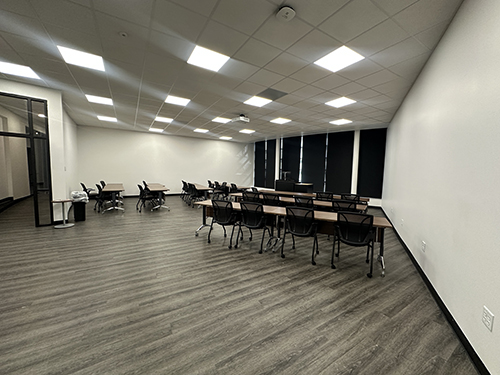
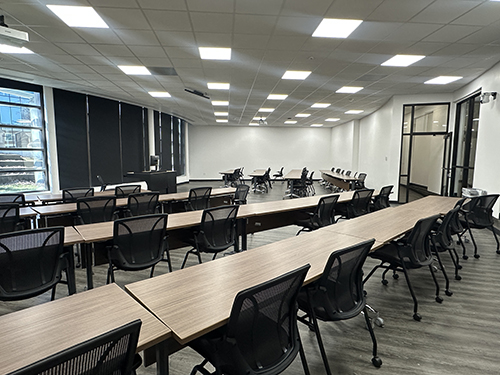
The School of Business classrooms at Marywood University are modern, technology-equipped learning spaces designed to support collaboration and professional development. These classrooms feature multimedia presentation systems, comfortable seating, and flexible layouts that encourage discussion, group work, and interactive learning. The environment reflects real-world business settings, helping students develop practical skills in areas such as management, finance, marketing, and entrepreneurship while working closely with faculty and peers.
The Michael and Dolores Insalaco Center for Studio Arts is home to the Art Department. The Insalaco Center also houses the Kresge, Mahady and Suraci Galleries and features drawing and painting studios showcasing naturally-lit rooms with beautiful views of the campus. There are studios and equipment for woodworking, jewelry-making, ceramics, sculpture, photography, printmaking, graphic design, illustration, and art therapy, and private and semi-private workspaces for upper-level BFA, MA, and MFA students. Private and semi-private work spaces are available to upper-level undergraduate and graduate students. Art students can access the building 24 hours a day.
Built and dedicated in 2001, the facility was made possible through the generous support of Michael Insalaco, Trustee Emeritus and former Board Chair, and his wife, Dolores.
The Insalaco Center for Studio Arts features drawing and painting studios showcasing naturally lit rooms with beautiful views of the campus. There are studios and equipment for woodworking, jewelry-making, ceramics, sculpture, photography, printmaking, multipurpose classrooms for graphic design and illustration, and private and semi-private studios for upper level BFA, MA, and MFA students.
The Clay Studio consists of a large common workroom with electric- and kick- wheels, extruders, slab roller, and worktables. Adjoining the workroom is a kiln and glazing room with four electric kilns and two gas kilns. Ceramics majors and minors also have access to personal workspaces that connect to the main workroom and kiln room.
Students in illustration, drawing, painting, and foundations have access to two adjacent studios, each about 800 square feet of uninterrupted space with 10 ft. ceilings. One studio has floor-to-ceiling windows extending 80 ft. along two walls. The other has floor-to-ceiling windows extending 40 ft. along one wall. Both studios are fully equipped with easels and taborets, as well as track lighting, student lockers, storage racks, and ventilation systems.
In addition, students have use of multipurpose classrooms equipped with negative, slide and flatbed scanners, large-format color inkjet printers, color plotters, and digital access to Adobe Creative Cloud software.
The large and airy third floor art studio offers dedicated space for novice through advanced painting students. The room has movable partitions for configuring semiprivate work areas according to class size. Six private art studios 12x15 overlook a stand of mature trees and provide plenty of natural light for each student pursuing a undergraduate degrees in studio art painting.
Graphic design, printmaking, and photography students have access to a group black and white darkrooms, a private darkroom for making large projection prints, and an alternative processes room devoted to working with historic printmaking methods such as palladium, cyanotype and gum bichromate. The department has seven 4x5 view cameras which are available for student use, along with a variety of 35mm and 2-1⁄4 cameras. The spacious lighting studio is equipped with versatile strobe systems, backdrops, and a prop zone. Resources include an adjacent multipurpose classroom equipped with negative, slide, and flatbed scanners, large-format color inkjet printers, color plotters and digital access to Adobe Creative Cloud software.
The second floor printmaking studio provides facilities for working in all the major processes. Currently there are there intaglio/relief presses, a litho press with stones and grinding sink, a letterpress proof press and assorted type, camera room, screen stretching unit and assorted frames, screen washout unit, NU ARC exposure units, and various paper filing and materials cabinets. Adjoining the main studio is a separate letterpress studio and a fully equipped papermaking facility including a Hollander paper beater.
The first floor 3D/sculpture area consists of mold-making facilities for casting metal, resins, plaster, and glass. Fabrication equipment allows students to cut, forge, weld, and cold-finish metal. The hot shop is outfitted with kilns for glass cutting. slumping, and fusing in addition to the foundry for bronze and aluminum. The jewelry studio bays provide opportunities for students to work with "light" metals. The wood studio, shared with Architecture, is designed and equipped for all aspects of woodwork as applied to furniture making and sculpture, including carving, lamination, turning, and finishing.
The Robert J. and Elizabeth FitzMartin Mahady Gallery, known more frequently as the Mahady Gallery, is located on the first floor of the Insalaco Center for Studio Arts, providing an open and elegant setting for the display of contemporary artwork. Throughout the year, the gallery offers a variety of group and solo shows by visiting artists, juried regional competitions, faculty exhibits, student shows, and curated national exhibitions. Every art major has an exhibit in the Mahady Gallery before graduation.
Formerly known as the Contemporary Gallery, the venue underwent renovations in 2001. Elizabeth Mahady, a generous benefactor, underwrote the remodeling of the space, which was renamed to honor her and her late husband. In 2025, the gallery was relocated to the lobby of the Insalaco Center for Studio Arts. The refurbished Mahady Gallery has continued to showcase works of talented students, faculty, and visiting artists, providing a source of artistic enrichment for all the people of the region.
The Maslow Study Gallery is a learning laboratory, providing fieldwork experiences, internships, and opportunities in curatorial and exhibition studies to Marywood students. Works in The Maslow Collection are available for professional research and study, and many are loaned to regional and national exhibitions.
The Maslow Collection is the largest and most comprehensive collection of Contemporary art in Northeastern Pennsylvania, with over 700 works by more than 150 artists. Collected by Marilyn and Richard Maslow and originally housed at InterMetro Industries, it is now on long-term loan to Marywood University.
The largest part of the Collection is devoted to paintings by newly established or emerging artists working or exhibiting in New York during the late 1970s through the early 1990s, such as David Reed, Terry Winters, Nicholas Africano, Robert Cumming, James Biederman, Jack Goldstein, Melissa Meyer, Gary Lang, Anthony Sorce, Edward Henderson, and Katherine Porter, among many others.
The Collection also includes major prints and works on paper by Jasper Johns, Frank Stella, Robert Rauschenberg, James Rosenquist, Roy Lichtenstein, Jim Dine, Robert Longo, Chuck Close, Sherrie Levine, Edward Ruscha, Jane Hammond, Peter Halley, Sol LeWitt, and Andy Warhol, among others; and important photographs by Bernd and Hilla Becher, Barbara Kasten, Lee Friedlander, Sandy Skoglund, and Mark Cohen.
The Maslow Collection has loaned works to major exhibitions at the Whitney Museum of American Art in NYC; The Corcoran Gallery of Art in Washington, DC; the Museum of Contemporary Art, San Diego, CA; P.S.1 Contemporary Art Center, Queens, NY; and the University of the Arts, Philadelphia, PA; among others.
The Collection is, at its core, a learning laboratory that provides exhibitions, dialogue, fieldwork experience, internships, and other opportunities in curatorial studies. Access begins with all Marywood Art Department students, who interact directly with the Collection as an enhancement of their course content (exhibitions are frequently co-curated by faculty members), and extends to Arts Administration students in a more in-depth way, as well as the larger community as a major resource through loans and events.
The Suraci Gallery, located on the first floor of the Insalaco Center for Shields Arts, houses a rotating selection of Marywood's permanent collection of fine and decorative art. Exhibitions in the Suraci Gallery also showcase regional and national artists; support art faculty work and scholarship; provide degree research and documentation opportunities for current and alumni art students; and foster community outreach projects and interests.
The gallery consists of three collections. The gallery's Asian Collection consists of ceramics, furniture, netsukes, inro, ivories, and prints. Bronze and marble sculpture, paintings, ceramics, glass, and French ivories comprise the 19th Century Collection. Religious icons, furniture, and 20th century works round out the Suraci Collection.
Located in the lobby of the Insalaco Center for Studio Arts, the Kresge Gallery is a versatile exhibition, critique, and lecture space. An alternative venue to the formal art galleries, the Kresge Gallery provides a working and experimental exhibition site for art students and faculty to showcase a variety of work throughout each semester.
Art Talent Awards are only available to incoming freshman students. Students who have already registered for classes are no longer eligible to apply for the award.
ELIGIBILITY:
If you are an incoming Freshman student and you would like primary consideration for an Art Talent Award, your portfolio AND art essay must be submitted together to the Art Department
by November 15
. Portfolios received after November 15 and before the cut off date of March 1 are still eligible for consideration depending on remaining awards. Awards are granted a rolling basis each spring beginning March 1 and portfolios meeting the November 15th deadline will get first consideration for available awards. The Art Talent Award is based on artistic merits. As such, Arts Administration students are ineligible for this award. Recipients of an Art Talent Award must plan to major in art at Marywood. Once awarded, they are renewable for up to eight semesters of full-time undergraduate study. If a Talent Award recipient changes his/her major to that of one outside of art, the Art Talent Award will be rescinded.
Note:
Any physical or flash-drive digital portfolios must be left with the Art Department 7-14 days for evaluation. Award recipients will be notified by mail sometime after March 1.
Fall & Spring Semesters First Year (31 total credits)
Course Numbers
Course Names
Credit Hours
Fall
16 total credits
ART 101
Foundation Seminar
1
ART 110
Basic Drawing
3
ART 118
2D Design/Color Therapy
3
ART 113
Art History 1
3
ENGL 160
Writing Skills
3
CORE
Oral/Spoken
3
Spring
15 total credits
ART 241
Digital Design
3
ART 212
3D Design
3
ART 114
Art History 2
3
ART 332
First Year Portfolio Review
0
RST 112
Encountering Faith
3
MATH
Math
3
Fall & Spring Semesters Second Year (33 total credits)
Course Numbers
Course Names
Credit Hours
Fall
18 total credits
ART 315A
Basic Photography
3
ART 210
Intro to Typography
3
ART 218
Art in the Modern Era
3
ART 441B
Motions Graphics
3
ART 441M
Digital Illustration
3
CORE
Writing Intensive
3
Spring
15 total credits
ART 116
Drawing I
3
ART 314
Intro to Visual Communication
3
ART 221A
Conceptual Design Thinking
3
ART 322A
Second Year Portfolio Review
0
CORE
Social Science (Psych, Soc, etc)
3
PHYS
Physical Science Elective
3
Fall & Spring Semesters Third Year (30 total credits)
Course Numbers
Course Names
Credit Hours
Fall
15 total credits
ART 442H
Interactive Design I
3
ART 416A
Comm & Conceptual Design I
3
ART 491
History of Visual Communication
3
LANG 150/250
Language Requirement I
3
PHIL 120/121
Introduction to Philosophy
3
Spring
15 total credits
ART 441 I
Interactive Design II
3
ART 416B
Comm & Conceptual Design II
3
ART 405
Advanced Typography
3
ART 322B
Third Year Portfolio Review
0
INT
Internship
3
CORE
Philosophy or RST Elective
3
Fall & Spring Semesters Fourth Year (27 total credits)
Course Numbers
Course names
Credit Hours
Fall
15 total credits
ART 416
Social Impact Design
3
ART 428
Design Business & Production
3
ART 448
Package Design
3
ART 322C
Fourth Year Portfolio Review
0
HIST
History Elective
3
XXX
Elective
3
Spring
12 total credits
ART 440
Advanced Portfolio
3
ART 422B
Interactive Design II
3
ART 455
Professional Contribution (Exhibit)
0
ENGL
English Elective (300+)
3
CORE
Core Category 5 Elective
3
Program Learning Outcomes
Students in the 3D (sculpture/ceramics) track take courses that stress a high level of creativity and innovation. This program is a self-directed degree that prepares students to be successful in the contemporary art economy. Technical areas to which students can be exposed include modeling, carving, forging, fabrication, mold making, bronze/aluminum/glass casting, production pottery, glaze chemistry, electric/gas/raku firing techniques and slipcasting. Students also have access to a comprehensive fibers studio including papermaking and weaving.
Student Resources
Foundations Year
Your first year as an art student at Marywood University is an important step in your development as an artist. To help make your foundation year a success, we offer a number of resources to guide you.
Explore the vibrant community and endless opportunities that await you at Marywood. Attend one of our special events designed specially for you to learn more about Marywood's degree programs, dedicated faculty, and welcoming campus.
Marywood University hosts three academic Centers of Excellence on campus; The Center for Law, Justice and Policy, The Center for Urban Studies, and The Mother Theresa Maxis, IHM Center. Each center provides students with the tools and resources to excel in their academic endeavors, fostering a dynamic environment where they can engage deeply with their respective fields of study and make meaningful contributions to their communities and beyond.